

The E-Invoicing Check helps you sort format questions, master-data gaps, validation and accounting handoff before committing to software or a consulting project.
Target state: a repeatable e-invoicing routine
Prepare data
Customer, tax, project, service and payment data is structured before the invoice is generated.
Create the format
Depending on the recipient, the workflow produces XRechnung, ZUGFeRD, Peppol UBL/CII or defined country-specific paths.
Validate and approve
Validation rules, visual review and business approval catch errors before sending or booking.
Archive and hand off
Structured file, visual copy, attachments, status and comments remain traceable for accounting and month-end close.
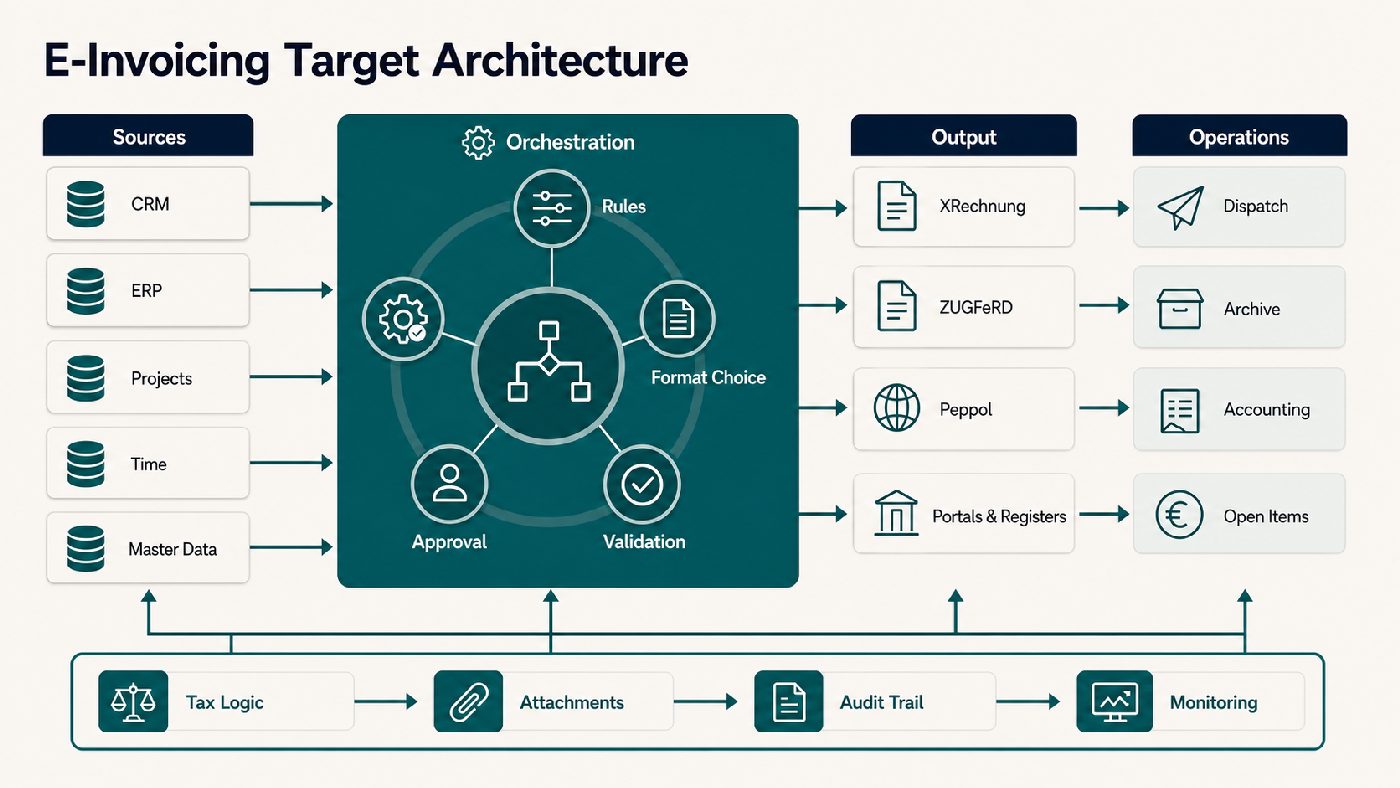
Accessible description and data
The visual shows a target architecture for e-invoicing automation: source systems, central orchestration, output formats, operating handoffs and controls are connected as one workflow.
Why we do not start with a PDF converter alone
Converter only
- Can only infer limited semantics from unstructured PDFs.
- Often moves master-data, tax and service logic into manual correction.
- Does not solve receiving, validation, archiving or accounting handoff.
Workflow approach
- Starts with the source data needed for a correct invoice.
- Separates format, validation, approval, archive and handoff clearly.
- Can later become SaaS, API or a managed workflow.
Possible support formats
| Format | Best fit | Outcome |
|---|---|---|
| Workflow Check | You need to structure the current state quickly. | Prioritised gaps and a next-step path. |
| Implementation sprint | Formats, data sources and approvals are roughly known. | Target workflow, rules, tests and handoff plan. |
| Recurring pilot | Monthly invoice runs should be accompanied reliably. | Operational process with review, documentation and improvement. |
