

Allow about five minutes: answer 24 short questions with Yes, Partly or No and receive your readiness assessment immediately.
Check your complete e-invoicing workflow now.
E-invoicing diagnostic
Assess your e-invoicing workflow
Answer the 24 checks online. The page shows a short summary; you can receive the full report with all gaps and recommended next steps by email.
01
Scope
1
Outgoing and incoming invoices are mapped by customer group, country and invoice type.
2
Customer groups, countries, invoice types and exceptions are documented.
3
B2B, B2G, cross-border and special cases are assessed separately.
02
Format decision
4
XRechnung, ZUGFeRD/Factur-X, Peppol or country formats are chosen by clear rules.
5
Recipient requirements and exchange routes are clear by invoice type.
6
There is a documented format rule instead of case-by-case knowledge.
03
Master data
7
Customer, tax logic, service period, references and payment data are complete.
8
Mandatory fields and data owners are visible.
9
Missing or contradictory data has a documented correction path.
04
Generation
10
The e-invoice is generated from structured source data.
11
Mapping, test files and validation are documented.
12
PDF reconstruction is clearly limited or excluded.
05
Receiving
13
Incoming e-invoices have defined and monitored intake channels.
14
XML or hybrid invoices can be made readable and assigned.
15
Duplicate logic, status and responsibility are defined.
06
Validation
16
Syntax, mandatory fields, profile and business rules are checked.
17
Business plausibility is reviewed before approval or booking.
18
Errors, rejections and corrections have a decision owner.
07
Archiving
19
Original file, visual copy, attachments and review status remain traceable together.
20
Version, access and retention path are clarified.
21
The process can later be reconstructed without relying on individual memory.
08
Handoff
22
Invoice, evidence, status and comments reach accounting as one package.
23
Coding, tax logic and month-end readiness have an accountable owner.
24
Internal accounting or tax advisory receives a clear month-end package.
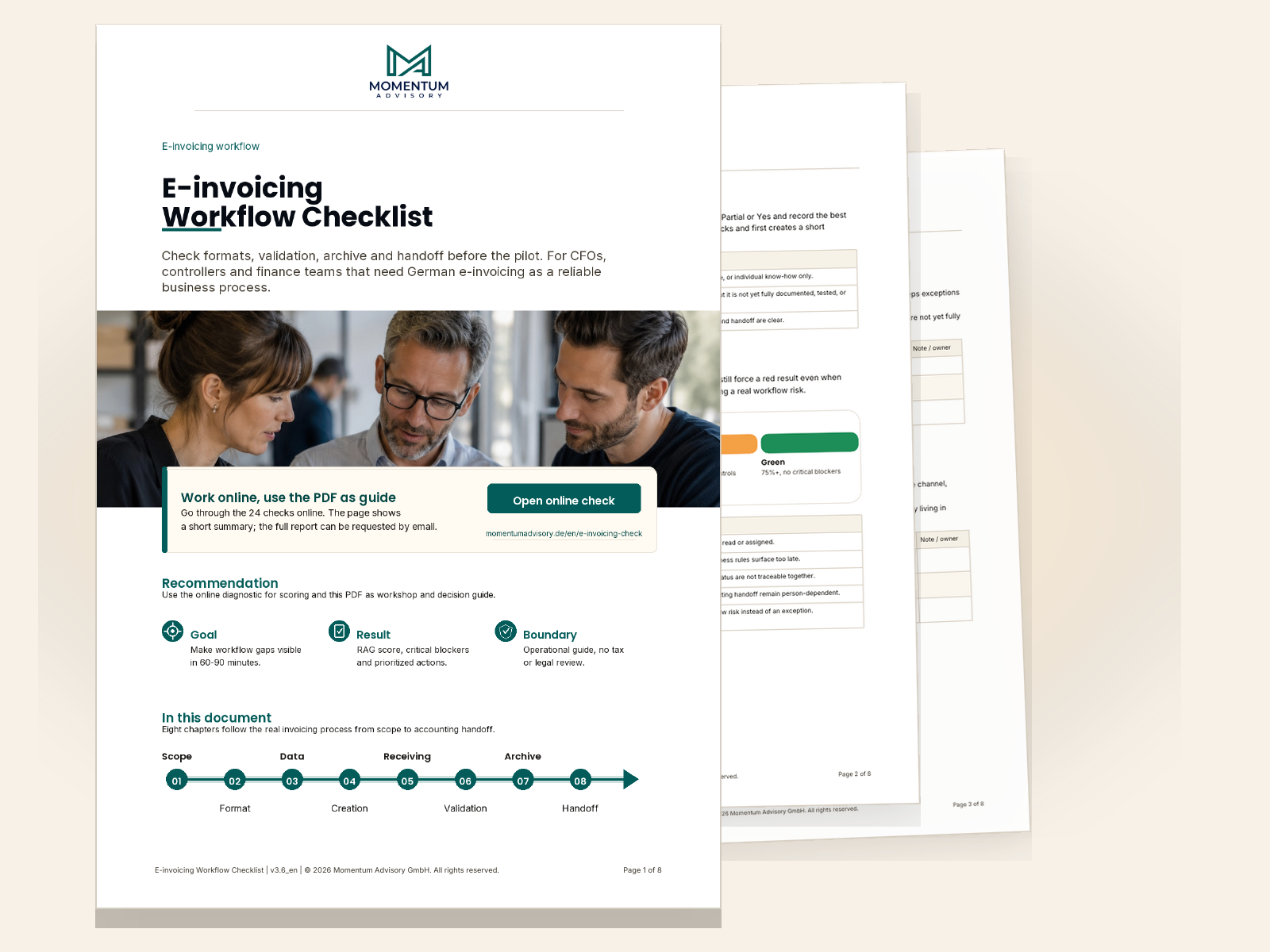
E-invoicing Workflow Checklist
PDF guide to use alongside the online check
English PDF checklist for international finance teams working through German e-invoicing requirements.
- 24 checks for the internal workflow review
- scoring logic, evidence package and action plan
- matches the online check for format, validation, archive and handoff
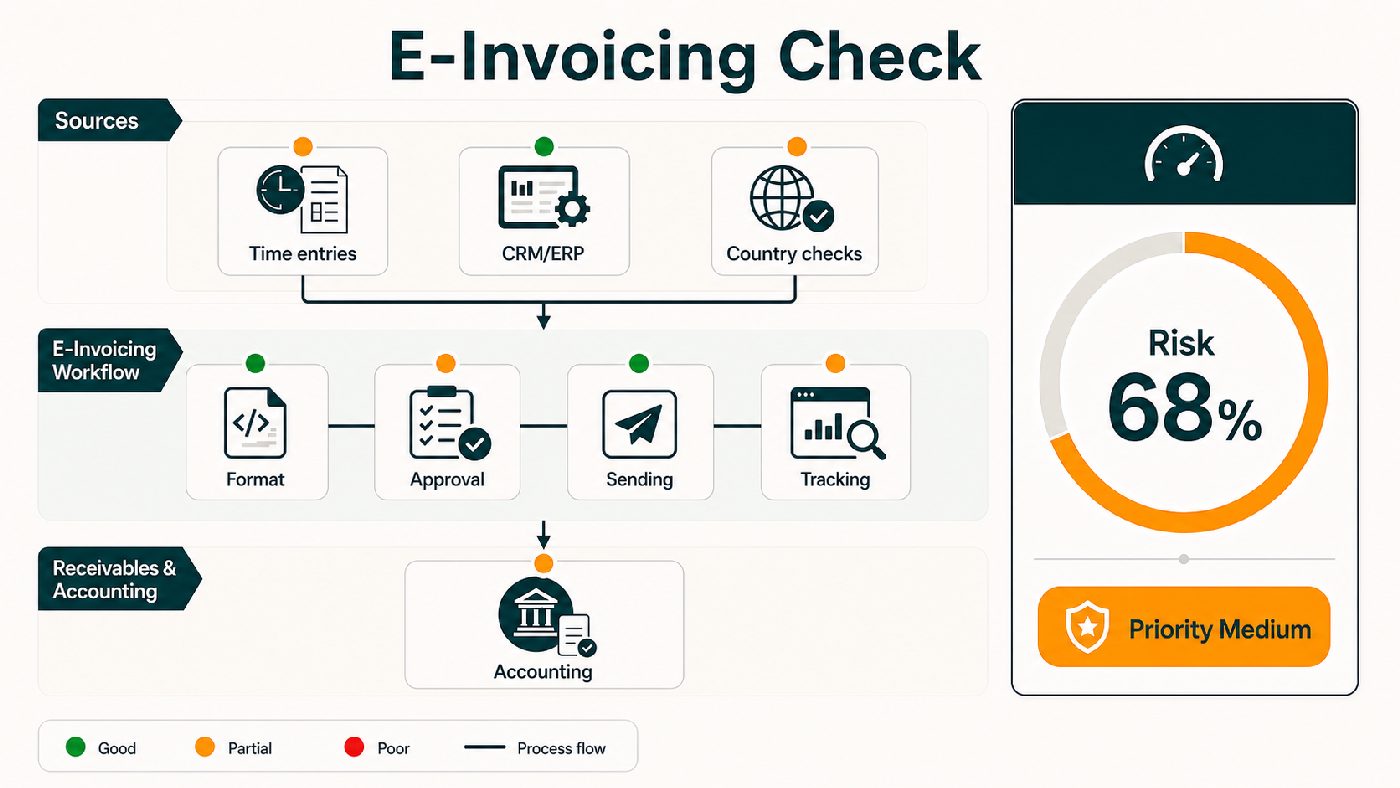
Accessible description and data
The infographic presents the e-invoicing check as a workflow map: operational sources feed format choice, approval, sending and tracking, while accounting and country checks remain visible controls.
The eight checks that matter
Do not stop at whether a system can export XML. The process before and after invoice creation determines whether e-invoicing works in daily operations.
| Check area | Decision question | Typical risk |
|---|---|---|
| Scope and recipients | Which customers, suppliers and invoice types are affected? | Wrong format choice or unnecessary exceptions. |
| Format decision | When do XRechnung, ZUGFeRD or Peppol profiles fit? | The invoice is valid XML but impractical for the recipient. |
| Master data | Are customer, tax, performance period and references structured? | Conversion fails or creates incorrect invoice data. |
| Generation | Is the e-invoice generated from structured data and documented mapping? | PDF reconstruction becomes an error source instead of an exception. |
| Receiving | Can incoming invoices be detected, read, assigned and monitored? | E-invoices arrive but are not reliably processed. |
| Validation | Who checks syntax, mandatory fields and business rules? | Errors surface only after sending or during accounting. |
| Archiving | Is the structured original preserved and traceable? | Only the visual PDF is stored while the relevant XML is lost. |
| Accounting handoff | How do invoice, attachments, evidence and status reach month-end close? | The e-invoice works technically while the finance workflow stays manual. |
From check to implementation path
Clarify the current state
Map invoice types, customer structure, software, export paths and responsibilities.
Choose the format route
Separate XRechnung, ZUGFeRD, EN 16931, Peppol and country formats by recipient and process.
Prioritise gaps
Rank master data, validation, approval, archiving and accounting handoff gaps by risk and effort.
Pick the next step
Depending on maturity, use the checklist, an implementation sprint or a recurring workflow pilot.
You may also be interested in

E-invoicing automation
For companies that want the check to become a repeatable workflow for outgoing and incoming invoices.
Open resource →
XRechnung or ZUGFeRD?
For teams that first need to clarify the format decision.
Open resource →

Project billing and e-invoicing
For professional-services teams that turn time entries and service records into invoice-ready packages.
Open resource →
Regulatory context
The practical baseline is Germany's e-invoicing obligation for many domestic B2B supplies from 2025 and the European EN 16931 standard. This page is not tax or legal advice. Companies should check the latest official guidance, the applicable standard documentation and their tax adviser for specific cases.
