

Short answer: recipient and process decide
XRechnung often fits stricter B2G and XML workflows. ZUGFeRD or Factur-X can fit better when a readable invoice and structured data should travel together. The recipient requirement remains decisive.
Format decision in practice
| Situation | Likely route | Why |
|---|---|---|
| German public-sector recipient | Check XRechnung | B2G processes often require XRechnung, buyer references and defined portals or exchange routes. |
| B2B customer needs machine data and a readable invoice | Check ZUGFeRD / Factur-X | Hybrid PDF/A-3 with embedded XML can connect visual invoice and structured processing. |
| Automated processing without visual PDF | XRechnung or UBL/CII profile | Pure XML can be clearer for systems but needs review and rendering processes. |
| International exchange through a network | Check Peppol / EN 16931 profile | The exchange route may matter more than the local format label. |
German E-Invoicing Workflow in 3 Minutes: Requirements, Formats and Handoff
The video explains German e-invoicing requirements, XRechnung, ZUGFeRD, UBL/CII, Peppol, validation, archiving, project billing and accounting handoff as one connected workflow.

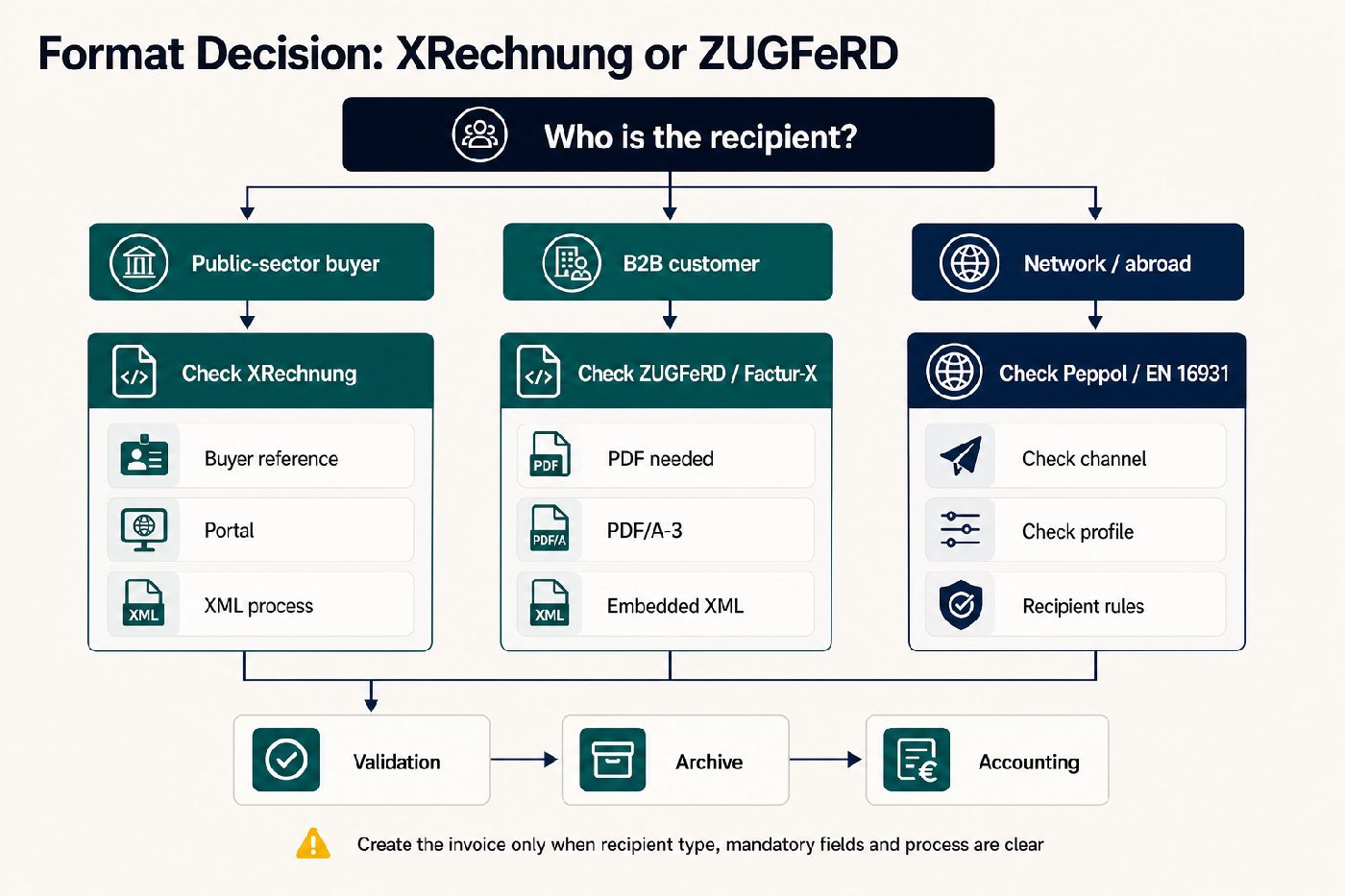
Accessible description and data
The infographic walks through a recipient-first decision tree for XRechnung, ZUGFeRD and Peppol, connecting format choice with validation, archive and accounting.
Common format mistakes
Format by familiarity
- A format is chosen because it sounds familiar.
- Recipient requirements, validation and archiving remain open.
Format by workflow
- Recipient, channel, mandatory fields, visualisation and accounting are checked together.
- The format decision becomes testable and documented.
Questions to answer before choosing a format
| Question | Why it matters |
|---|---|
| Is the recipient a public-sector buyer or a B2B customer? | B2G requirements, buyer references and portals differ clearly from many B2B workflows. |
| Does the recipient need a readable PDF? | ZUGFeRD/Factur-X can fit when the embedded XML is also correct from a business perspective. |
| How will validation and archiving work? | The chosen format must fit validation rules, visual copy, original file and accounting handoff. |
Check the format decision in the workflow
Use the E-Invoicing Check if you do not want to treat XRechnung, ZUGFeRD, validation and archiving separately.
Standards note
XRechnung is the German public-sector e-invoicing standard. ZUGFeRD and Factur-X use a hybrid combination of visible PDF/A-3 and embedded structured invoice data. EN 16931 is the key European reference; specific recipient requirements remain decisive.

Heinrich Ruhwasser
Heinrich Ruhwasser is a seasoned entrepreneur and advisor with more than twenty years of experience in digital transformation, corporate strategy, and succession planning. As an expert in business growth, he has successfully guided a wide range of companies through complex transformation initiatives. His core area of expertise is increasing enterprise value, where he applies his deep knowledge to long-term planning and seamless business succession. Heinrich’s combination of visionary thinking and hands-on experience makes him a trusted advisor to executives and business owners.
How would you rate this article?
Did this article help, or is something missing? Your feedback goes straight into improving our articles.
We review every response and use it to improve both content and reading flow.
Related reading

E-Invoice Conversion: PDF, XRechnung, ZUGFeRD and structured data
Why safe e-invoice conversion starts with structured source data and why PDF-to-XRechnung is often risky.

E-Invoicing Formats in Europe: EN 16931, UBL, CII, Peppol, XRechnung, ZUGFeRD and KSeF
A practical overview of relevant European e-invoice formats, standards and national systems without thin country pages.

E-Invoicing in Germany: obligations, formats and workflow
What companies need to know about German e-invoicing: 2025 obligation, XRechnung, ZUGFeRD, receiving, validation, archiving and practical next steps.