
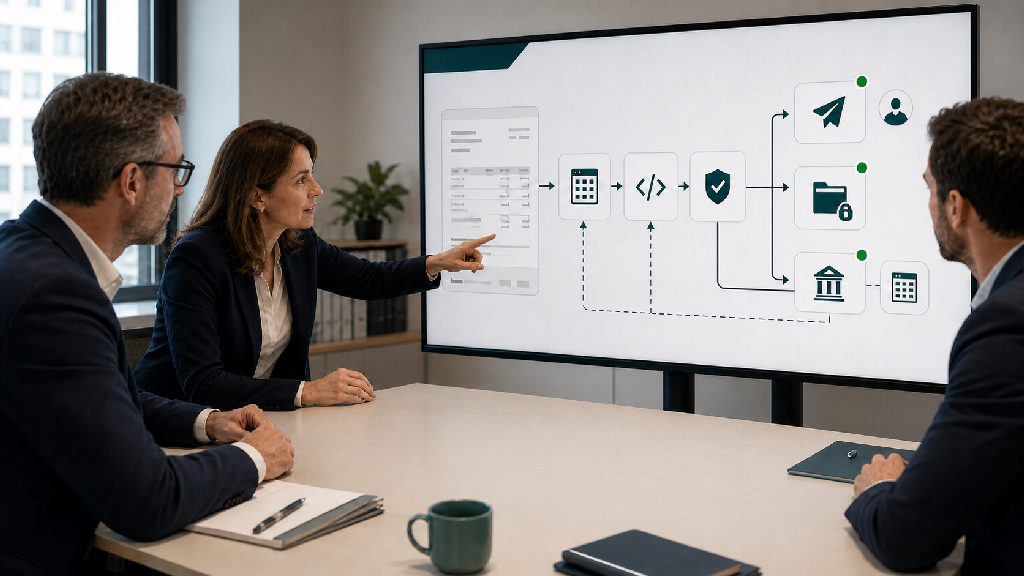
Short answer: e-invoicing is a workflow topic
The obligation makes structured invoices important, but practical success depends on receiving, master data, validation, archiving and accounting handoff. Creating a format alone usually does not solve the process.
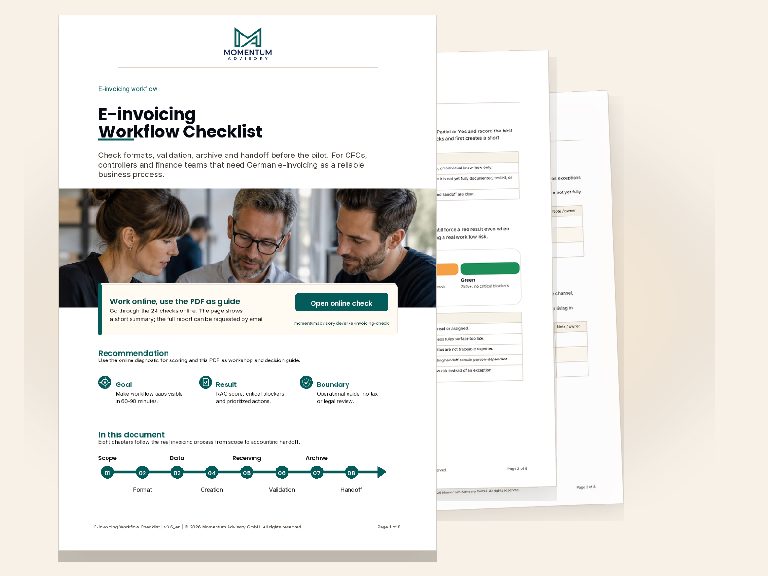
E-invoicing workflow checklist
Compact orientation for format, validation, archive and handoff
If German e-invoicing is moving closer on your roadmap, use the checklist as a focused starting point and then open the readiness check.
German E-Invoicing Workflow in 3 Minutes: Requirements, Formats and Handoff
The video explains German e-invoicing requirements, XRechnung, ZUGFeRD, UBL/CII, Peppol, validation, archiving, project billing and accounting handoff as one connected workflow.
What changed from 2025
For many supplies between domestic German businesses, e-invoicing became the regular expectation from 1 January 2025. A simple PDF is not an e-invoice in the stricter sense because the invoice must be issued, transmitted and received in a structured electronic format that enables electronic processing. Transitional rules and exceptions apply; specific cases require tax review.
Operationally, the important point is this: companies must be able not only to send e-invoices, but also to receive, visualise, validate, archive and hand them off to accounting.
Orientation for German e-invoicing
| Topic | Meaning for companies |
|---|---|
| From 2025 | E-invoicing becomes the regular path for many domestic German B2B supplies; receiving capability becomes practical. |
| Transitional rules | Issuing obligations become effective in phases. Revenue size, timing and case type need review. |
| PDF alone | An unstructured PDF is not an e-invoice; it is treated as another invoice form. |
| B2G | Public-sector invoicing has its own requirements, including XRechnung and buyer reference contexts. |
| ViDA | EU digital VAT reporting plans make structured invoice data strategically more relevant. |
Formats you should be able to place
| Format | Typical context | Next step |
|---|---|---|
| XRechnung | Public-sector recipients and XML-oriented processing. | Compare with ZUGFeRD and check recipient requirements. |
| ZUGFeRD / Factur-X | Hybrid invoice with PDF/A-3 plus embedded XML. | Check whether people and systems can process the same invoice. |
| UBL / CII | European syntax routes under EN 16931 and Peppol contexts. | Treat as target syntax, not just a buzzword. |
| Peppol BIS Billing | Network and exchange context, often in public procurement and cross-border processes. | Go deeper only when a recipient or network path requires it. |
Accessible description and data
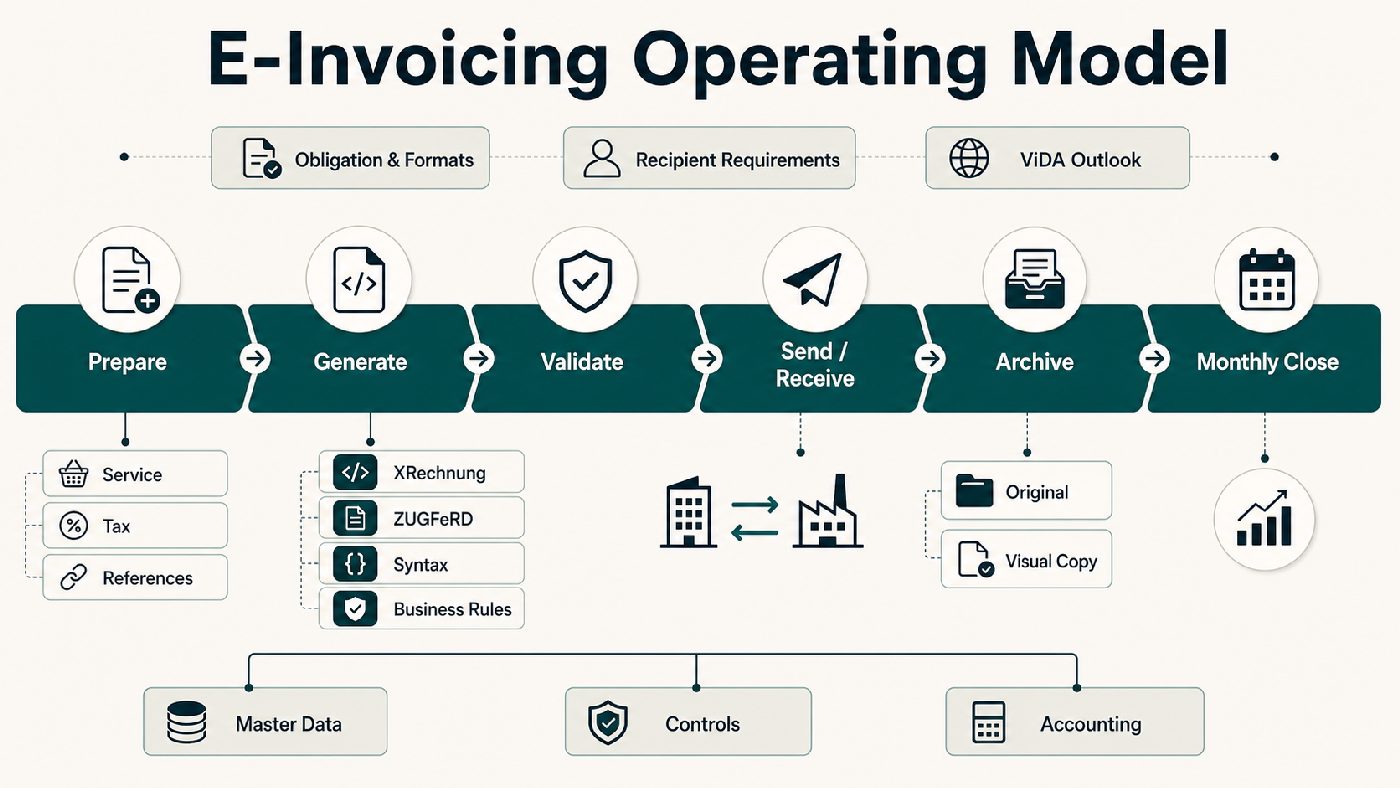
The visual positions German e-invoicing as an operating model with preparation, generation, validation, sending or receiving, archiving and monthly close, supported by governance and data foundations.
The practical e-invoicing workflow
Invoice preparation
Clarify service, tax treatment, references, order numbers, payment terms and recipient requirements.
Format and validation
Generate the invoice from structured data and validate mandatory fields, syntax and business rules.
Sending or receiving
Email, portal, Peppol or another channel must fit the recipient and internal controls.
Archive and accounting
Original file, visual copy, attachments, review status and coding remain traceable.
Sources and limits
The current baseline comes from the German Federal Ministry of Finance FAQ, European EN 16931 documentation, XRechnung guidance from KoSIT/XStandards Einkauf and Peppol specifications. This page translates the operational implications and does not replace tax or legal advice.
Related pages on e-invoicing
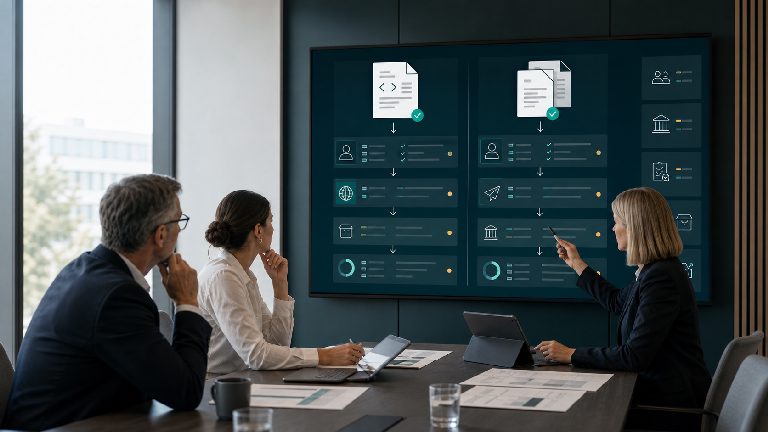
XRechnung or ZUGFeRD?
Make the format decision based on recipient, readability and workflow.

E-invoice conversion
Why safe conversion starts with structured source data.
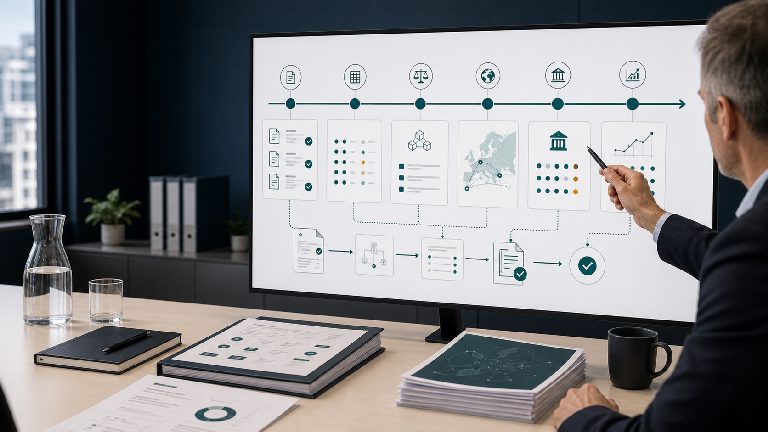
ViDA and e-invoicing
Why digital invoice data matters for future VAT reporting.

Heinrich Ruhwasser
Heinrich Ruhwasser is a seasoned entrepreneur and advisor with more than twenty years of experience in digital transformation, corporate strategy, and succession planning. As an expert in business growth, he has successfully guided a wide range of companies through complex transformation initiatives. His core area of expertise is increasing enterprise value, where he applies his deep knowledge to long-term planning and seamless business succession. Heinrich’s combination of visionary thinking and hands-on experience makes him a trusted advisor to executives and business owners.
How would you rate this article?
Did this article help, or is something missing? Your feedback goes straight into improving our articles.
We review every response and use it to improve both content and reading flow.
Related reading
E-Invoice Conversion: PDF, XRechnung, ZUGFeRD and structured data
Why safe e-invoice conversion starts with structured source data and why PDF-to-XRechnung is often risky.

E-Invoicing Formats in Europe: EN 16931, UBL, CII, Peppol, XRechnung, ZUGFeRD and KSeF
A practical overview of relevant European e-invoice formats, standards and national systems without thin country pages.
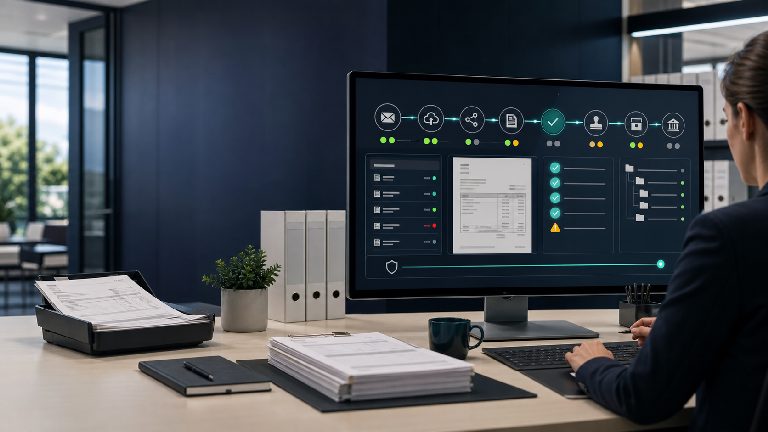
Receiving, validating and archiving e-invoices in Germany
How companies receive, visualise, validate, approve, archive and hand off structured German e-invoices to accounting.