
Short answer: Europe is not a one-format market
EN 16931 provides the semantic baseline, but syntax, network, national platform and recipient requirements vary. That is why one maintained atlas is more useful than thin country pages.
Maintenance status
Status: 9 July 2026. This overview is intended as a maintained working atlas. Before format decisions, we recheck the relevant primary sources, especially EU eInvoicing, Peppol BIS Billing 3.0, XRechnung / XStandards Einkauf, FeRD ZUGFeRD/Factur-X, KSeF, FatturaPA and Facturae.
German E-Invoicing Workflow in 3 Minutes: Requirements, Formats and Handoff
The video explains German e-invoicing requirements, XRechnung, ZUGFeRD, UBL/CII, Peppol, validation, archiving, project billing and accounting handoff as one connected workflow.
Format and system atlas
This table is orientation, not legal or country-specific advice. Recipient requirements, local rules and current specifications remain decisive.
| Name | Role | Practical note | Primary source |
|---|---|---|---|
| EN 16931 | European semantic standard for core electronic invoice elements. | Important for meaning; syntax and national rules come on top. | EU eInvoicing / EN 16931 |
| UBL 2.1 | One European syntax binding for invoices and credit notes. | Often relevant in Peppol and international contexts. | EU eInvoicing syntax list, Peppol |
| UN/CEFACT CII | Another syntax binding, including hybrid ZUGFeRD/Factur-X contexts. | Do not confuse it with the visual PDF rendering. | EU eInvoicing syntax list, FeRD |
| Peppol BIS Billing 3.0 | Specification for invoice exchange in the Peppol network. | Relevant when recipient or public-sector process requires Peppol. | Peppol BIS Billing 3.0 |
| XRechnung | German public procurement e-invoicing standard. | Buyer references, portals and recipient rules must also be checked. | XStandards Einkauf / KoSIT |
| ZUGFeRD / Factur-X | Hybrid invoice with PDF/A-3 and embedded structured data. | Useful when visual invoice and machine processing should stay together. | FeRD ZUGFeRD/Factur-X |
| KSeF | Polish national e-invoicing and exchange system. | Needs separate technical and organisational review if Poland is relevant. | Polish Ministry of Finance / KSeF |
| FatturaPA | Italian electronic invoice format and exchange context. | Do not treat it as a generic EU format. | FatturaPA / Agenzia Entrate |
| Facturae | Spanish e-invoice format, especially known in public-sector contexts. | Check national requirements and recipient routes. | Facturae official portal |
Accessible description and data
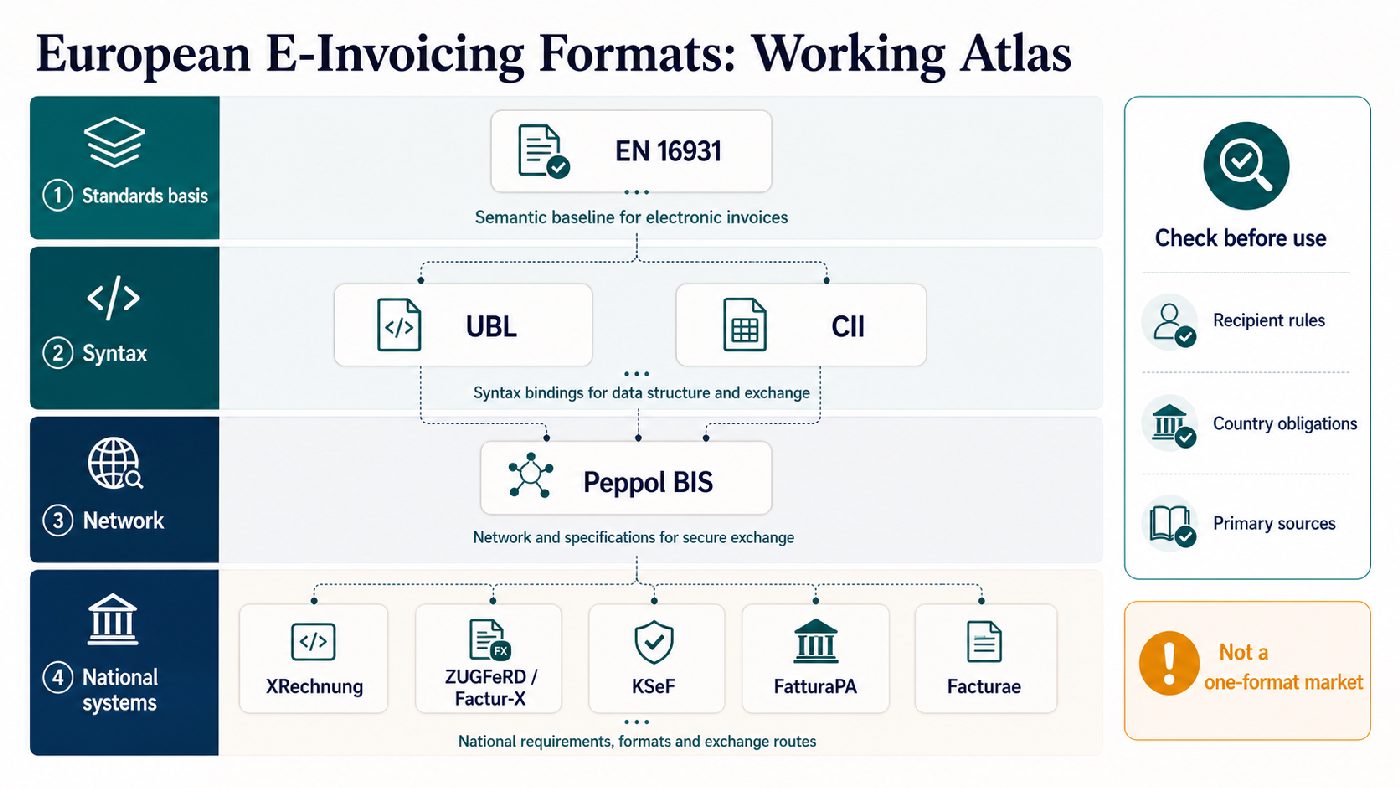
The matrix maps European e-invoicing formats by standard basis, syntax, network and national systems and shows where an official-source check remains necessary.
Why this is not a set of thin country pages
A series of superficial country articles would not help search visitors or buyers. The real question is whether your company invoices in that country, is VAT registered there, supplies public-sector recipients or must use a network such as Peppol. Only then does a deep country review become useful.
KSeF as a special case with its own review path
For companies with Polish exposure, KSeF is not a generic EU format but a separate technical and operational review path. Check early whether registration, API access, archive and ownership are affected.
When the atlas needs a recheck
| Trigger | What we check | Limit |
|---|---|---|
| New specification version | Official release notes, syntax files, validation artifacts and code lists. | No automatic technical sign-off for your system. |
| National mandate or platform change | Start date, scope, registration rules, API or portal requirements. | No legal or tax advice. |
| Specific recipient route | Portal, Peppol, buyer reference, API, archive and status requirements. | The recipient requirement remains decisive for the individual case. |
Primary sources and limits
The main starting points for maintaining this atlas are the European Commission eInvoicing Hub, Peppol BIS Billing 3.0, XRechnung at XStandards Einkauf, FeRD ZUGFeRD/Factur-X, KSeF, FatturaPA and Facturae. We link primary sources, not arbitrary secondary lists. This page translates sources into operational orientation and does not replace tax, legal or country-specific review.

Heinrich Ruhwasser
Heinrich Ruhwasser is a seasoned entrepreneur and advisor with more than twenty years of experience in digital transformation, corporate strategy, and succession planning. As an expert in business growth, he has successfully guided a wide range of companies through complex transformation initiatives. His core area of expertise is increasing enterprise value, where he applies his deep knowledge to long-term planning and seamless business succession. Heinrich’s combination of visionary thinking and hands-on experience makes him a trusted advisor to executives and business owners.
How would you rate this article?
Did this article help, or is something missing? Your feedback goes straight into improving our articles.
We review every response and use it to improve both content and reading flow.
Related reading

E-Invoice Conversion: PDF, XRechnung, ZUGFeRD and structured data
Why safe e-invoice conversion starts with structured source data and why PDF-to-XRechnung is often risky.
E-Invoicing in Germany: obligations, formats and workflow
What companies need to know about German e-invoicing: 2025 obligation, XRechnung, ZUGFeRD, receiving, validation, archiving and practical next steps.
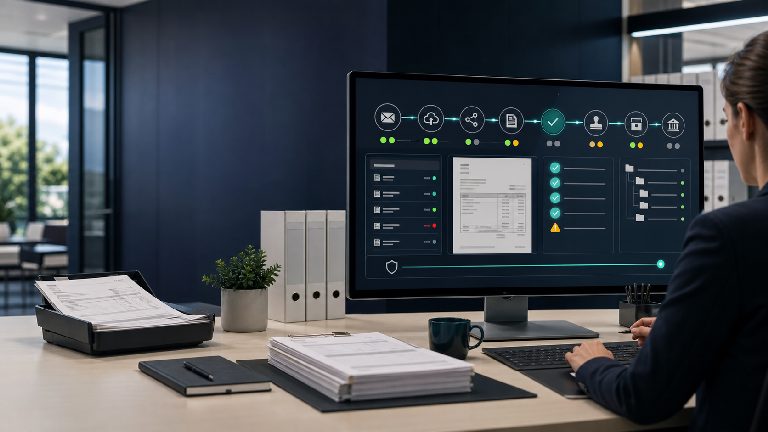
Receiving, validating and archiving e-invoices in Germany
How companies receive, visualise, validate, approve, archive and hand off structured German e-invoices to accounting.