
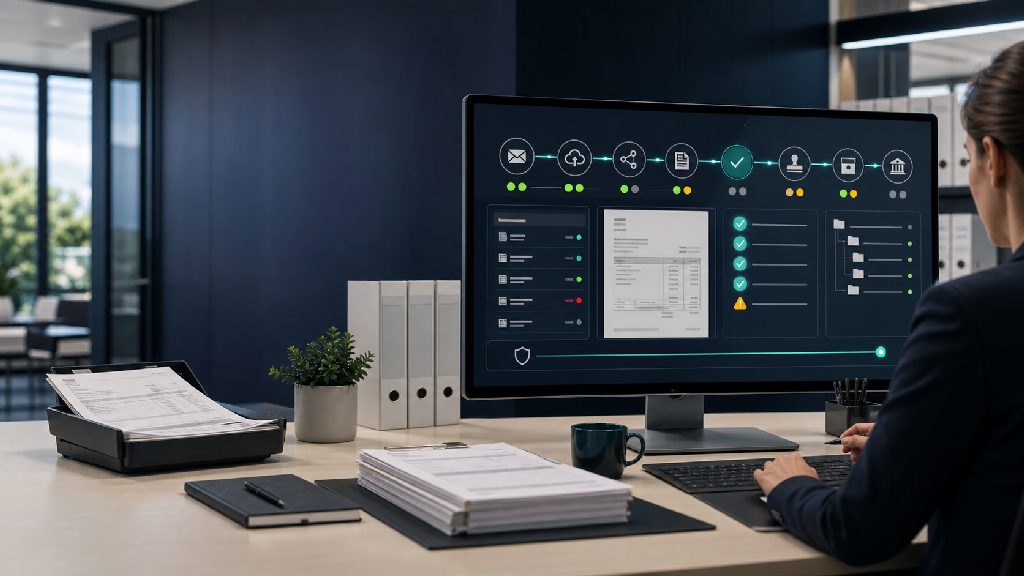
Short answer: receiving is a control process
If e-invoices are only stored, the benefit is lost. Incoming files must be rendered, validated, approved, archived and connected to accounting status.
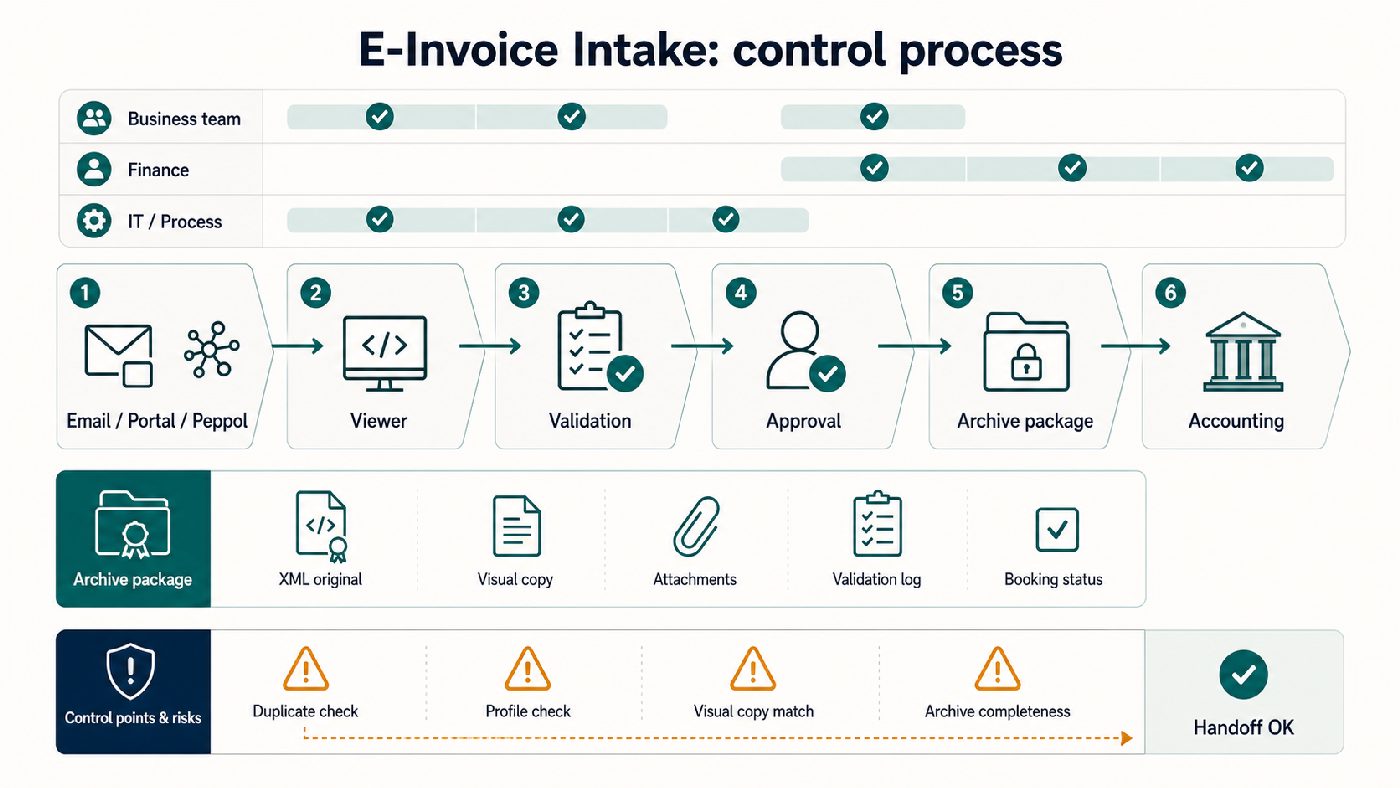
Six steps for incoming e-invoices
Define the intake channel
Email, portal, Peppol or upload routes need monitoring and ownership.
Make the invoice readable
XML invoices need reliable visualisation so business teams can review them.
Validate technically
Syntax, mandatory fields, profiles and business rules should be checked before approval and booking.
Approve commercially
Service, purchase order, project, cost centre and payment release remain business decisions.
Archive
Structured original file, visual copy, attachments and review status should remain traceable together.
Hand off to accounting
Coding, tax logic, document status and payment information must fit the month-end process.
Accessible description and data
The infographic shows the incoming control process from intake channel and viewer through validation and approval to archive package, accounting and control points.
Controls that often go missing
| Control | Why it matters |
|---|---|
| Duplicate check | E-invoices can arrive through several routes; without status, teams review the same invoice twice. |
| Format and profile validation | An XML file can exist but still not match the expected profile. |
| Visual copy comparison | For hybrid formats, visual invoice and structured data must stay consistent. |
| Archive completeness | XML, visual file, attachments and approval status should be traceable together later. |
Ownership in the incoming workflow
| Role | Responsibility |
|---|---|
| Business team | Review service delivery, purchase order, project reference and commercial approval. |
| Finance / accounting | Secure tax logic, coding, payment status and month-end readiness. |
| IT / process owner | Run intake channels, viewer, validation, archive interfaces and monitoring. |
Example: what belongs in a traceable invoice evidence package
A good archive package makes the later review path understandable. It does not replace tax or legal review for a specific case, but it reduces avoidable reconstruction during month-end.
| Component | Purpose | Caution |
|---|---|---|
| Structured original file | Basis for machine validation and later traceability. | Do not replace it with a PDF-only copy. |
| Visual copy or viewer output | Business teams can review service, amount and recipient clearly. | Visual copy and structured data must stay consistent. |
| Validation log | Shows format, mandatory fields and business-rule checks at the review date. | It is not proof that the tax treatment is correct. |
| Approval and booking status | Connects business approval, coding, payment and month-end close. | Roles and timestamps must remain traceable. |
Next steps for the incoming workflow
Use the compact checklist as a working base, then check receiving, validation, archive and handoff in the online tool.
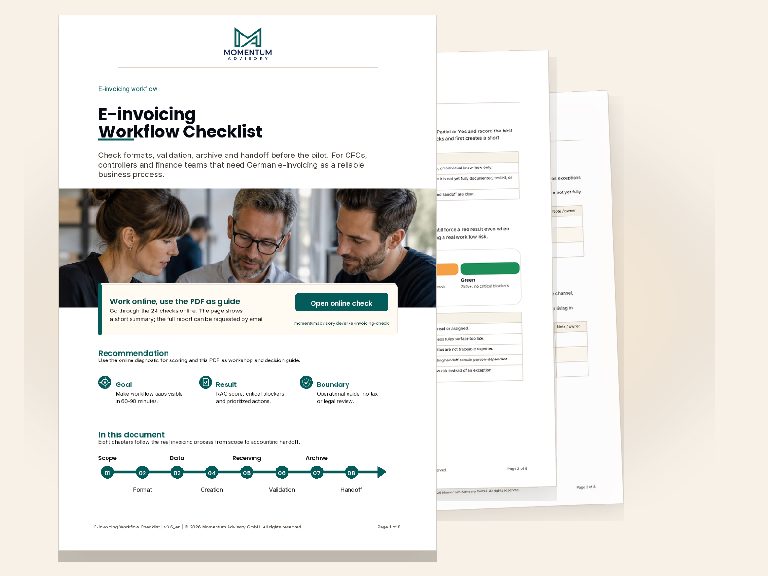
E-invoicing workflow checklist
PDF guide for receiving, validation, archive and handoff
A compact working base to surface missing controls, evidence and ownership in the incoming invoice process.

E-invoicing Check
Check receiving, validation, archive and handoff together
The online check places the incoming workflow and shows where gaps can appear before invoice volume rises.

Heinrich Ruhwasser
Heinrich Ruhwasser is a seasoned entrepreneur and advisor with more than twenty years of experience in digital transformation, corporate strategy, and succession planning. As an expert in business growth, he has successfully guided a wide range of companies through complex transformation initiatives. His core area of expertise is increasing enterprise value, where he applies his deep knowledge to long-term planning and seamless business succession. Heinrich’s combination of visionary thinking and hands-on experience makes him a trusted advisor to executives and business owners.
How would you rate this article?
Did this article help, or is something missing? Your feedback goes straight into improving our articles.
We review every response and use it to improve both content and reading flow.
Related reading

E-Invoice Conversion: PDF, XRechnung, ZUGFeRD and structured data
Why safe e-invoice conversion starts with structured source data and why PDF-to-XRechnung is often risky.

E-Invoicing Formats in Europe: EN 16931, UBL, CII, Peppol, XRechnung, ZUGFeRD and KSeF
A practical overview of relevant European e-invoice formats, standards and national systems without thin country pages.
E-Invoicing in Germany: obligations, formats and workflow
What companies need to know about German e-invoicing: 2025 obligation, XRechnung, ZUGFeRD, receiving, validation, archiving and practical next steps.